
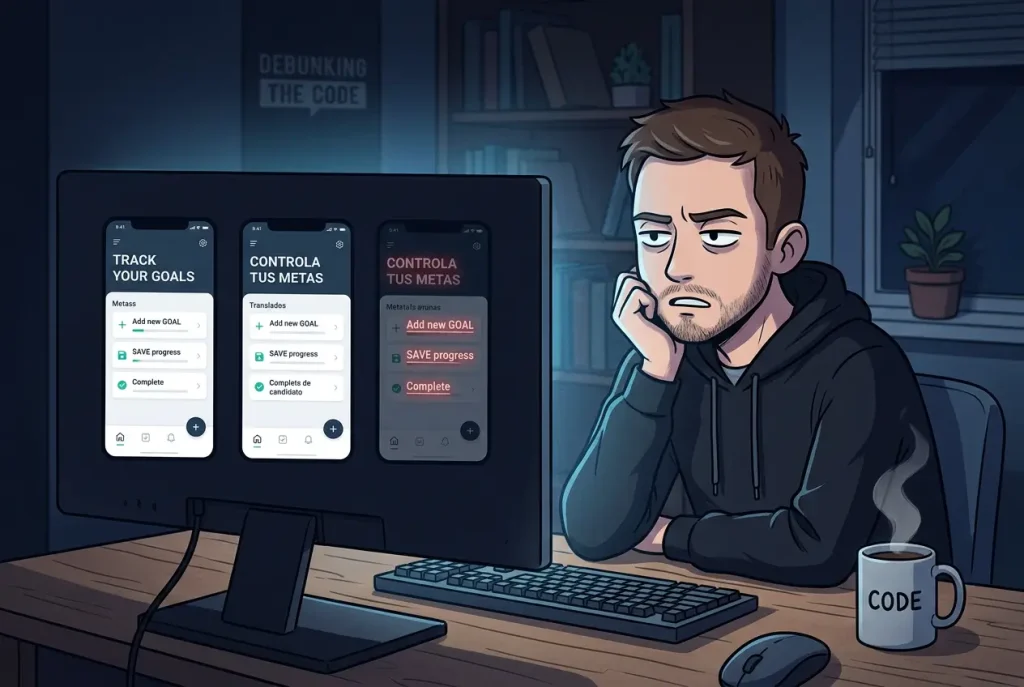
Building an app is a lot like cooking a big dinner. You’re focused on getting everything on the table while it’s still hot, and somewhere along the way you forget to add salt to one of the dishes. Nobody notices until someone takes a bite.
We’ve been building Focido for several months now, and one of those “forgot the salt” moments hit us harder than expected.
From the very beginning, we wanted Focido to feel at home in three languages: English, Russian, and Spanish. Our users are in different countries, and we wanted everyone to feel like the app was made for them, not just translated for them. That’s a meaningful difference.
But here’s the thing. We use AI to help us write code faster. And AI, just like a really productive intern, sometimes gets so focused on the task at hand that it forgets the bigger picture. Ask it to build a new screen? Done in minutes. But did it remember to translate every little button, every label, every tiny message on that screen? Not always.
At some point we looked at the app in Spanish mode and found over 50 pieces of text stubbornly sitting in English, scattered across 15 different screens. Nothing was broken. The app worked perfectly. But it felt like a guest who keeps slipping into a language you don’t speak.
We fixed it. Went through every screen, found every stray English string, and put everything where it belonged. It took a while, but it was worth it.
More importantly, we changed how we work. Now, localization isn’t an afterthought that we check at the end. It’s baked into our process from the first line of code. Every new feature gets reviewed for language consistency before it ever reaches you.
We share these moments not because we want to complain, but because we think you deserve to know how Focido is being built. Not by some faceless team shipping features in the dark, but by people who actually care when something feels off.
The app you open should feel like it was made for you. That’s what we’re building.