
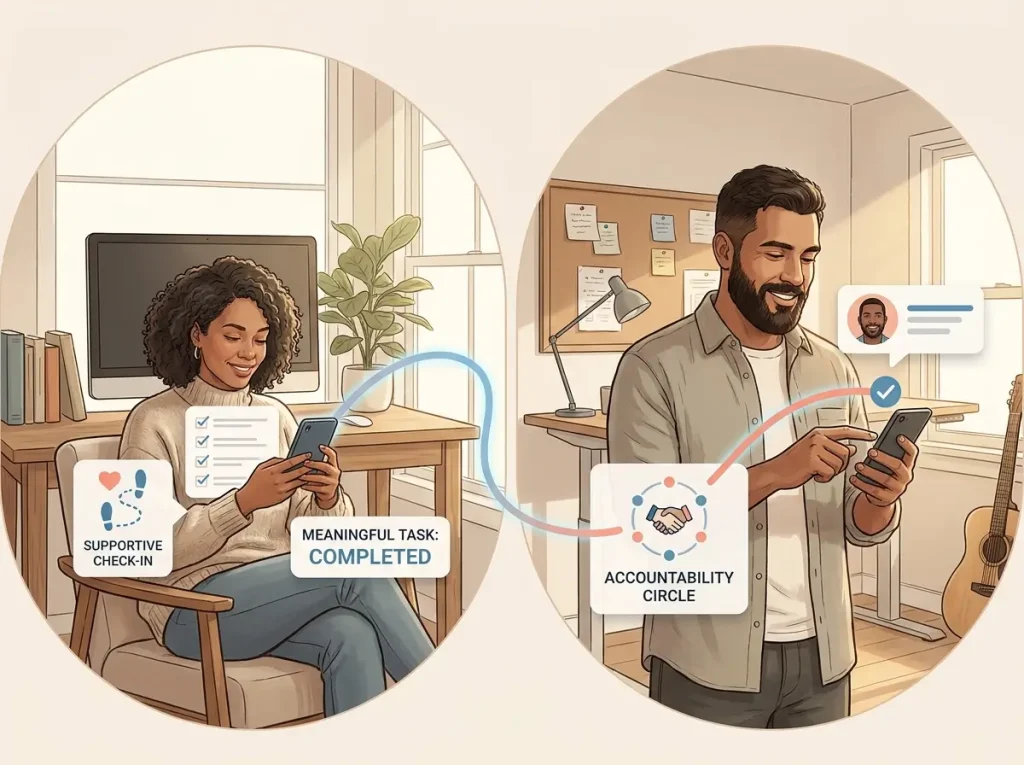
Coaching rarely breaks down because a client lacks insight. A client may understand the goal, recognize their patterns, and leave a session with a great plan. The harder part is taking the first step on a Tuesday morning, returning to the task after a rough day, and staying engaged between sessions. That is where Focido comes in: it helps turn agreements into visible action, with human accountability that does not rely on shame or pressure.
“To help people achieve more, together. To replace lonely productivity with human support. To make accountability feel natural.”
Focido’s mission.
Coaching Does Not End at the Call
A client can have a powerful one-hour session, then disappear into six days of silence. Not because they are lazy. Not because they do not want change badly enough. Real life just has a way of eating attention: work, family, anxiety, notifications, and the eternal “I’ll do it later.”
Coaches know this pattern well. During the session, the client identifies a goal, chooses an action, and promises to report back. Then the week begins. The action stays in a notebook, the notebook stays closed, and the momentum fades.
Focido is designed around a different assumption: a task should not have to survive alone. A person can create a goal, keep it private or make it public, connect with a motivator, receive short nudges, and mark the work as done. It does not replace a meaningful coaching conversation. It supports the part that happens after the conversation, when insight has to meet real life.
For a coach, that is a meaningful shift. Instead of “I need to remember to check in,” the client has an environment where their commitments can stay visible, supported, and actionable.
A Growing Profession, A Real Challenge
Coaching is growing quickly and becoming more diverse. The International Coaching Federation reports 122,974 coach practitioners worldwide, up 15% from 2023, with global industry revenue reaching $5.34 billion. Its 2025 study drew on responses from more than 10,000 practitioners across 127 countries.
Growth creates opportunity, but it also creates a practical problem. A coach cannot endlessly add more manual check-ins, chat messages, spreadsheets, and reminders. If between-session support lives entirely in WhatsApp, Slack, Telegram, and the coach’s memory, the practice eventually hits a ceiling.
The ICF also found that coaches often deliver much more than coaching: 60% offer training, 57% consulting, 55% facilitation, and 49% mentoring. Modern coaches do not simply need another video-call tool. They need flexible ways to support programs, groups, challenges, and consistent client practice.
That is the role Focido can play. Not a CRM for the sake of CRM. Not another dashboard clients open once a month. It can become the action layer of a coaching practice: where small commitments, real effort, encouragement, and proof of progress happen.
What Focido Gives Coaches
At its core, Focido follows a simple flow: create a task, get a motivator, achieve the goal. Its onboarding language frames the journey as “Create task → Get motivator → Achieve.”
For a coach, this can become a natural continuation of a session.
| Coaching need | How Focido can help |
|---|---|
| Keep clients focused between sessions | Clients turn intentions into specific tasks that remain present in daily life. |
| Create accountability without micromanaging | Motivators can send short nudges, while clients respond or confirm completion. |
| Run a cohort or group program | Public and private clubs can organize people around a shared challenge and daily progress. |
| Make progress visible | Activity feeds, proof of work, XP, levels, and leaderboards create clear feedback loops. |
| Reduce chat overload | Goals, status, action proof, and interaction history provide context beyond “How’s it going?” |
The important point is that Focido is not trying to turn coaches into automated systems. It keeps the human element, while making that human support more timely, lighter, and more specific. Focido also clearly states that it is not therapy; motivators and coaches support accountability, not mental-health or medical treatment.
Accountability Without Shame
The word “accountability” can sound harsh. Done badly, it becomes surveillance. Done well, it is simply a respectful reminder that someone’s goals matter.
That is why supportive accountability matters. The tone is not, “You failed again.” It is, “You said this mattered. What would help you take the next small step?”
“Focido is not therapy. Motivators are regular people and coaches who help with accountability, not mental health or medical advice.”
This approach can be valuable for coaches working with habits, career change, founders, freelancers, creative professionals, fitness goals, or learning. In many of these situations, clients do not need one more piece of advice. They need a moment of reconnection with the decision they already made.
Imagine a client changing careers. In a session, she chooses three next actions: update her résumé, contact two people in the field, submit one application. In a typical week, that list can disappear among browser tabs and urgent messages. In Focido, those actions can have deadlines, visibility, and a small amount of real human support. When one item is completed, progress becomes an event instead of an invisible intention.
Clubs, Not Endless Chats
Many group coaching programs live inside messaging apps. That works at first. Eventually, though, the chat becomes a flood of voice notes, reactions, side conversations, and announcements that vanish before people can act on them.
Focido offers another format: clubs. They can be public for open challenges or private for a closed coaching cohort. Members can share daily progress, participate in challenges, and support one another in a dedicated space.
For a coach, a club could become the home for a 21-day program, a career sprint, a morning-routine community, a founder circle, or a group preparing for a major life or professional transition. The goal is not to force everyone into competition. The goal is to create a shared norm: people here do not merely talk about goals, they act on them.
There is a quiet social effect at work, too. When someone sees another member take a small step, their own next step can feel more possible. When they post proof of their effort, they are not just reporting in. They are strengthening an identity: I am someone who follows through.
Small Actions Beat Perfect Plans
Many productivity apps try to organize a person’s entire life: folders, tags, priorities, integrations, boards, color-coded systems. That can be useful. It can also become a sophisticated way to avoid starting.
Focido asks a more direct question: What action will you actually take, and who can help you stay with it? In the product concept, the north-star measure is not merely the number of tasks created. It is the number of completed tasks with an active motivator each week.
That distinction matters for coaching. A stated goal is not a transformation. A beautiful plan is not a practice. A busy chat is not progress.
With Focido, a coach can focus on observable signals:
- The client defined a clear, concrete action.
- The action has a deadline.
- The client received support when it was needed.
- The client confirmed completion.
- The coach and client can learn from what actually worked.
Over time, the objective is not dependency on the coach. It is a more reliable personal system for follow-through.
Gamification With a Point
People like seeing movement. Not always because they want a virtual badge, though that can be fun. More often, it is because big goals are made of dozens of small decisions that would otherwise go unnoticed.
Focido’s product concept includes XP, levels, rewards, streaks, profiles, and leaderboards. For coaches, the point is not the game mechanic itself. It is the feedback loop: effort gets acknowledged quickly.
Consider a client who takes one small action toward launching a project every day for a week. They start to see themselves differently. Not as someone who will “someday” build a business, but as someone already building it. That identity shift can matter more than another motivational quote in an Instagram carousel.
The gamified layer should remain optional and safe. Not everyone wants a leaderboard. Not everyone wants goals to be public. Focido’s concept includes public and private modes, reporting and blocking tools, notification controls, and quiet hours.
Starting With Focido
The best place to begin is not a massive program with hundreds of people. It is a small experiment with five to ten clients.
- Choose one clear theme: job search, fitness consistency, a creative project, studying, or a business launch.
- Create a short cycle, such as 7, 14, or 21 days.
- Ask every participant to choose one measurable action for the first 24 hours.
- Create a private club or use an individual client-and-motivator setup.
- Agree on a rhythm: one daily proof of action, one brief check-in, and one weekly reflection.
- At the end, review both the results and the system: what helped, what got in the way, and when support was most useful.
The coach does not need to become a 24/7 dispatcher. Their role can become clearer: set the container, help clients choose a realistic action, spot patterns, offer perspective, and reconnect people with the values behind their goals.
Where an App Ends
No app can replace trust, professional ethics, thoughtful questions, or the ability to sit with a client in uncertainty. A nudge cannot solve a complex life decision. A deadline cannot turn burnout, grief, or a mental-health crisis into a productivity problem.
Focido works best when used for what it is: a tool for goals, habits, follow-through, and human accountability. The service explicitly says that it is not therapy. When a client needs mental-health, medical, or crisis support, a coach should refer them to an appropriately qualified professional.
But when the next step is already clear, Focido can be genuinely useful. Not as a digital supervisor. As a friendly environment where a commitment does not have to face procrastination alone.
Coaching That Lives Between Sessions
The future of coaching does not necessarily mean more calls, more chat messages, or more manual reporting. It may mean creating a better bridge between a meaningful conversation and the ordinary moments that follow it.
Focido offers coaches a simple but powerful idea: support can be regular, human, and lightweight. Clients do not have to wait for the next session to reconnect with a goal. Every week does not need to feel like a test. Small actions can be noticed, and follow-through can become more natural.
Because most clients do not need another perfect plan.
They need a place to begin, and people who can calmly ask: “I see what matters to you. What is the next step you can take today?”